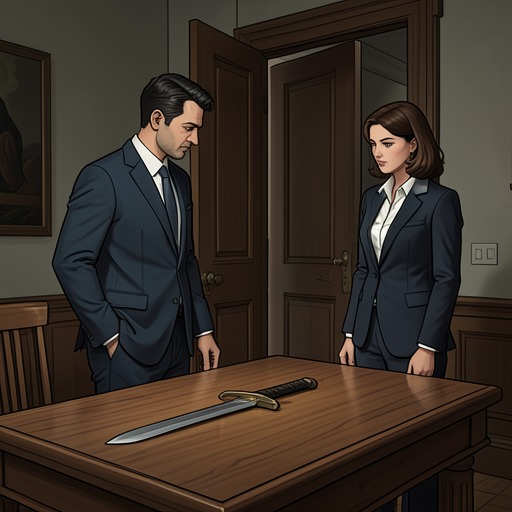
Swords in the Stone
The Portable DoorThe Swords in the Stone are not merely an impossible test of strength: their blades conceal two brittle keys that Paul Carpenter and Sophie Pettingell recover and use to unlock the Portable Door. Their discovery turns an apparently immovable object into a puzzle of recognition and cooperation, while Paul’s suspicion that someone other than Humphrey Wells arranged the keys leaves their purpose open.
Appearance and Hidden Construction
At first, the swords seem to offer a choice between supernatural explanation and brute force. Sophie Pettingell has tried to move one, as has her father, and neither has succeeded. Mr Tanner’s mum proposes that Humphrey Wells may have protected it with a spell or made it an intelligence test. Sophie, by contrast, suggests buying a jackhammer. The competing explanations and proposed solutions keep attention on the sword as an obstacle, until Paul Carpenter notices a different possibility.
Paul’s thought joins Gilbert and Sullivan with the idea that two hearts are better than one. He asks Sophie to take the opposite side of the crossguard, and they pull together. The sword comes free so easily that they nearly fall over. Its tip is not pointed or sharp: it is blunt, irregularly edged, and shaped like the wards of a key. The weapon’s most important feature is therefore not its familiar blade or its resistance in the stone, but the incongruous key form concealed at its end.
That detail changes the terms of the problem. The swords do not yield to force applied by one person; Paul and Sophie’s shared effort reveals that the blade tips are useful for another purpose. The scene does not explain the mechanism that made the swords so hard to shift, or confirm whether Humphrey enchanted them. Instead, the object’s construction supplies a practical clue where their earlier attempts supplied only frustration.
Extraction and Recovery
After examining the first blade, Paul takes hold of its key-shaped portion and bends it sideways. The metal is brittle, and the tip snaps off. He pockets the key, returns the sword to the stone, and reattaches the washing line. His actions separate the concealed working part from the visible sword while restoring the scene’s outward appearance: the key is now removed, but the sword is again in place.
Paul marks this as only the first key. The group has enough expense money for a taxi from Wimbledon to Kentish Town, where they draw the second sword. It comes out as readily as the first, and its key breaks off in the same way. The recurrence confirms that the first discovery was not an isolated oddity: the second sword has a matching concealed piece, recovered by the same method. The swords’ paired structure matters because the Portable Door has two locks, and the object yields not a single answer but a set.
The Keys and the Portable Door
With both keys recovered, Paul takes the Portable Door from its cardboard tube, smooths it out, and attaches it to a wall. He tries the first key in the upper lock; it fits perfectly. Its counterpart fits the lower lock as well. The close correspondence between the key tips and the door’s locks resolves the puzzle in material terms: the blunt shapes that looked wrong for swords prove exactly suited to opening something else.
Yet fitting the locks does not settle who put the keys inside the swords. Before using them, Paul pauses and says that he does not think Humphrey Wells placed them there; he believes someone else did. This is Paul’s stated theory, not a confirmed identification of the person responsible. The swords therefore provide a solution to the immediate problem of the door while preserving a larger question about the arrangement and its author.
Recurrence and Significance
The swords link an apparently legendary image—a blade held fast in stone—to an ordinary, functional key. Their significance lies in that mismatch: what looks like a weapon and a test of strength becomes a hiding place for the precise objects needed to operate the Portable Door. The key is not found by defeating the stone through greater force, but by noticing the blade’s unusual edge and working together to release the sword.
The image returns later at Paul’s flat. When Paul comes back, he notices that the sword in the stone is no longer there and remembers why. The moment confirms that the object’s presence has changed, but does not, in the available account, explain the circumstances of its disappearance. The swords’ role thus extends beyond their first extraction: they are both a concealed route to the paired door locks and a recurring reminder that the visible object may not disclose its actual use.